
Travel journal
Plan your Egypt journey well
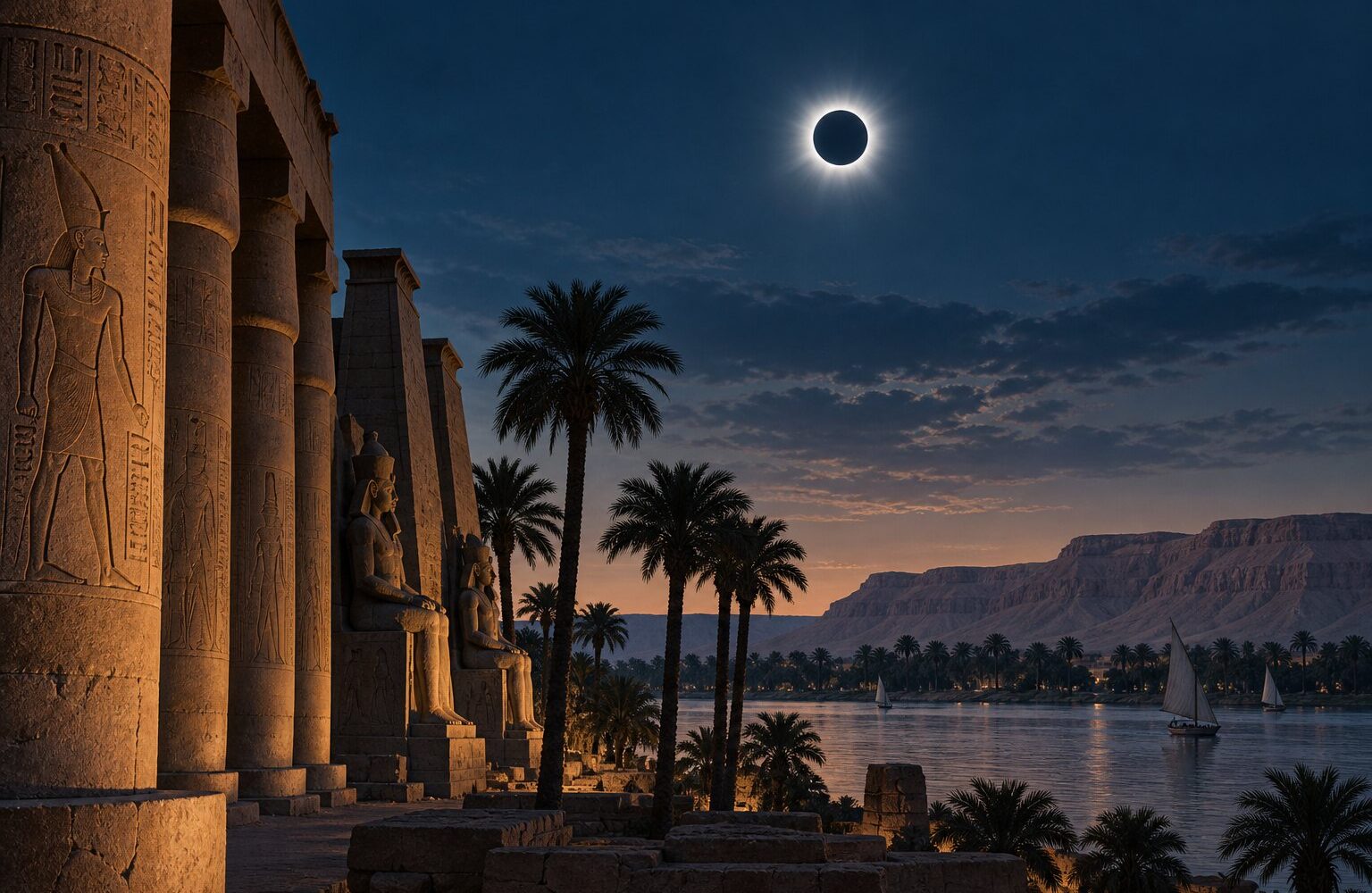
← All articlesOn 2 August 2027, totality at Luxor is calculated to last about 6 minutes 22 seconds, with local maximum around 13:05. Exact values vary by coordinates, and not all of Egypt lies within the path of totality. The hotel, observation site and transfer plan are therefore fundamental parts of the experience.
Totality depends on the exact place
“An eclipse in Egypt” is too broad a description. Outside the narrow path of totality, the eclipse remains partial; even within the path, start time, maximum and duration change slightly. Check a precise observation point and save its coordinates, route and contact details offline. Mobile networks may be strained around a major event.
Luxor offers unusually long totality, but astronomy does not guarantee a clear view. Cloud, dust or a blocked horizon can intervene. An organiser should explain whether the site has an open outlook, safe access, toilets, shade and a workable response to late changes. “Near Luxor” is not a precise enough location.
Eye protection is central
During the partial phases, look at the Sun only through suitable eclipse viewers. Ordinary sunglasses are not safe. Inspect filters for damage and follow the maker’s instructions. Children need direct supervision; an unprotected glance is not a reasonable shortcut.
Cameras, binoculars and telescopes require a suitable filter fitted over the front of the optics. Eclipse glasses worn at the eyepiece do not protect against concentrated light from an unfiltered device. Totality has specific viewing guidance; follow current instructions from reputable astronomy sources and the responsible team on site. Practise the sequence before the day.
Plan for midday heat and crowds
The Luxor maximum falls in early afternoon. In August, shade, drinking water, head covering, somewhere to sit and a heat plan belong in the core itinerary. Waiting for hours in an exposed area may be more demanding than the minutes of totality.
Expect traffic before and after the event. Avoid tight onward connections and agree a meeting point if the group separates. Confirm what the package provides and what guests must bring. Treat availability or prices as firm only once written terms identify the date and service.
A resilient observation strategy
Choose the observation site first, then fit accommodation and transport around it. Arrive early, inspect viewers and camera settings without looking at the Sun, protect equipment from heat and preserve an unobstructed line of sight. A second reachable site can help only if a competent local team can make a safe, timely weather decision.
Nebu may coordinate travel components with independent operators, but this preview does not confirm a special programme for 2 August 2027. Ask for observation coordinates, supervision, protective equipment, transfer windows and cancellation terms. For a once-only event, clear responsibility matters more than a long list of extras.
Eclipse planning checklist
- Observation coordinates are inside the path of totality
- Timing for that exact point checked and stored offline
- A sound, suitable eclipse viewer is available for each person
- Front-mounted solar filters planned for cameras, binoculars and telescopes
- Shade, water, heat response, meeting point and generous transfer buffer confirmed
Frequently asked questions
When is maximum eclipse in Luxor?
Current calculations place the local maximum around 13:05 on 2 August 2027. Exact timing depends on the observation coordinates.
Are normal sunglasses sufficient?
No. Suitable eclipse viewers are required throughout the partial phases.
Can I use binoculars while wearing eclipse glasses?
No. Optical devices need an appropriate filter over the front aperture; eclipse glasses at the eyepiece are not enough.
Sources and notes
- timeanddate.com: eclipse circumstances for Luxor — Local timing and duration calculation; coordinate-dependent.
- NASA: Future Eclipses — Event overview and totality path.
- NASA: Eclipse Safety — Core eye and optical-equipment safety guidance.