Travel journal
Plan your Egypt journey well
Nebu Reisen editorial team
Published:
Updated:
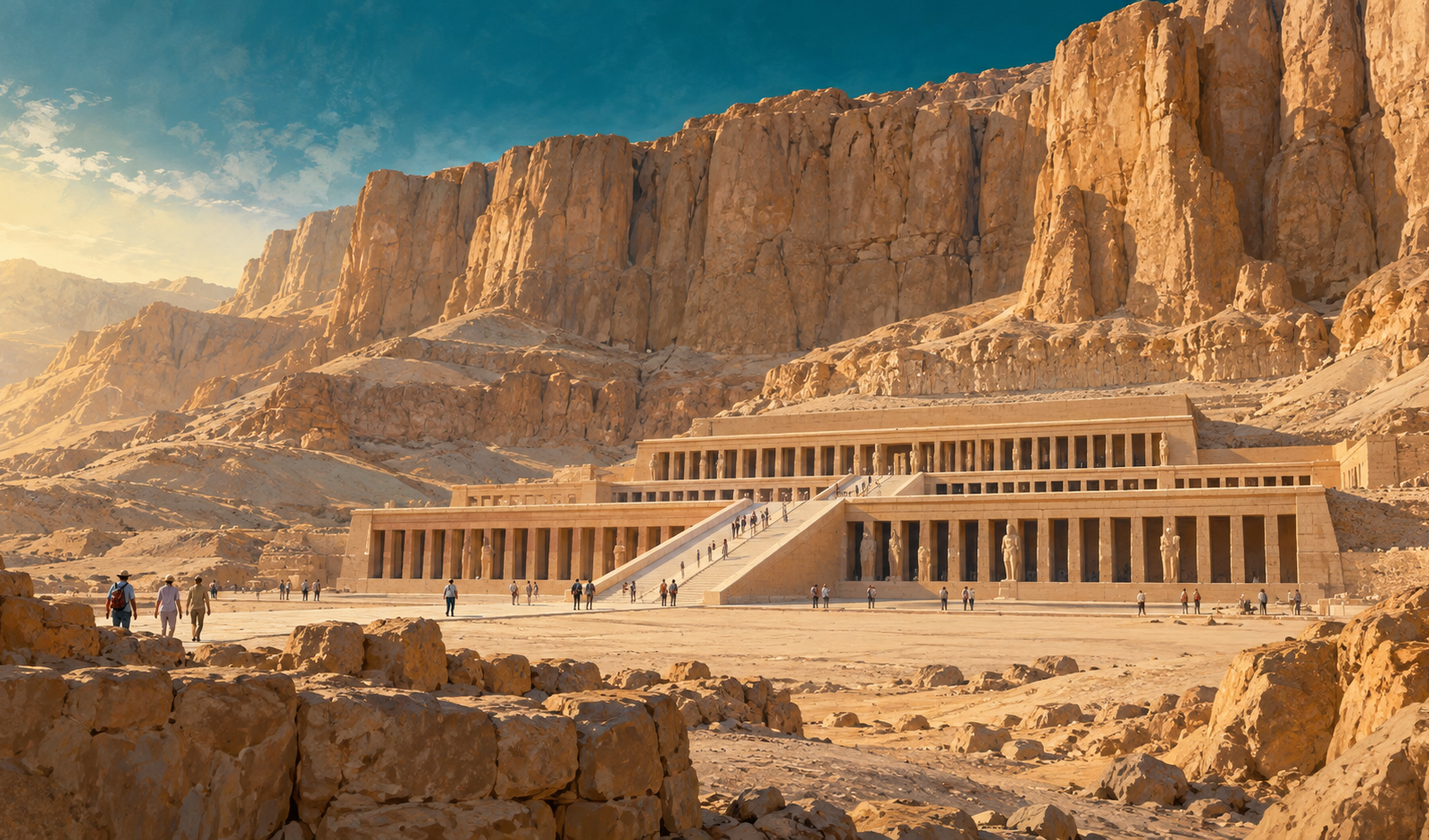
Imagine pausing in front of Hatshepsut’s Temple. The terraces draw horizontal lines across a sheer cliff. People on the paths look small, while the building seems both ordered and surprisingly light. Before walking up, enjoy that view: a ruler gave her remembrance an unmistakable shape here.
The temple at Deir el-Bahari is one of the most rewarding encounters on Luxor’s west bank. Its appeal is not only architectural. Its stories concern power, trade, divine origins and how a woman became visible as pharaoh. You do not need a long list of kings to appreciate it. A few well-chosen scenes make the place personal.
A woman holding the office of pharaoh
Hatshepsut ruled as pharaoh and used the imagery of that office. Traditional royal insignia, including crowns and a ceremonial beard, can therefore appear in her royal representations. They belonged to an understanding of kingship larger than an individual person.
The interesting point is how those symbols connect with the actual story of a female ruler. Ask your guide how Hatshepsut is shown in accessible images and what each representation communicates. Instead of reducing her story to unusual clothing, you meet a woman who used royal tradition to express her own rule.
The temple served the mortuary cult of Hatshepsut and her father, Thutmose I. It was not simply her tomb. That distinction helps if you visit the Valley of the Kings on the same day: a temple could maintain royal remembrance and offerings within religious life, while a tomb held the body and burial.
The voyage to Punt: Egypt looks beyond its horizon
The expedition to Punt is among the temple’s best-known visual stories. Its reliefs describe a journey to a trading partner in the southern Red Sea region. Punt’s precise location is still debated. For your visit, the idea behind the images is particularly engaging: people travel, encounter other ways of life and bring back valued goods.
Incense and plants play important roles in the story. Ask about surviving images of ships and goods brought home, where these are accessible and visible on your visit. A relief suddenly becomes a travel account that a queen arranged for posterity.
These scenes give Hatshepsut’s reign a different flavour from the usual pictures of battles and conquest. They show trade, organisation and the wish to make achievements visible. That suits a holiday in which you want to discover human connections as well as great stones.
Hathor and a protective mountain landscape
The cliffs were more than a dramatic background. The Deir el-Bahari area was closely associated with Hathor. The goddess could appear as a cow and was connected with care, the nourishment of kings and the west as a realm of the dead.
The mountain behind the temple therefore gains religious meaning. What first looks like scenery to a visitor could be understood as a space of divine protection. A brief explanation of Hathor changes how you look at the whole complex, not only one figure.
Stories of divine origins also belong to Hatshepsut’s self-presentation. Her imagery linked the king with Amun and expressed religious legitimacy. That is the perspective through which to read such scenes: a carefully told royal origin story.
See the whole setting, then choose a detail
A comfortable walk begins with the view from below. Take in the terraces, ramps and cliff together. Then choose one visual story, perhaps Punt or Hathor, rather than trying to study every surviving relief with equal attention.
A second viewpoint on an accessible terrace can add to the experience. You do not have to reach every level to understand the architecture. A carefully chosen view and a clear story are not an incomplete visit; they often make the better memory.
Plan thoughtfully for sunshine and slopes
The open complex can be sunny and warm. Ramps are still slopes, even where no steps are immediately visible. Before booking, clarify which levels and paths are planned, where you can rest and what assistance can be provided.
Older travellers or visitors with limited mobility benefit from a shorter route with clear priorities. Water, sun protection and shoes with a secure grip help. Do not expect every famous relief to be guaranteed accessible: conservation work and visitor arrangements can affect the walk.
The private Luxor excursion starting in Hurghada lists Hatshepsut’s Temple in its programme. This excursion begins in Hurghada, not Luxor. If you are already staying in Luxor, discuss an appropriate local arrangement. Our Luxor excursions help you compare the options.
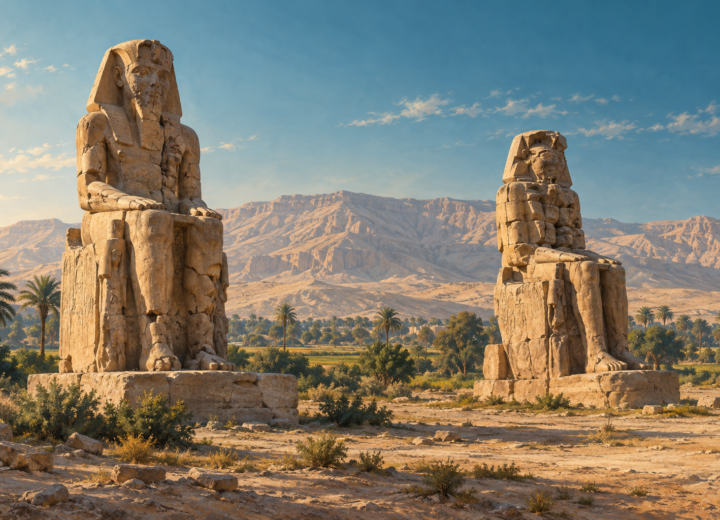
The nearby Colossi of Memnon add another royal place of remembrance. There too, a short explanation offers more than a quick photograph without context.
Questions visitors ask about Hatshepsut Temple
Is the temple Hatshepsut’s tomb?
No. It was built for the royal mortuary cult. A mortuary temple and a burial place performed different roles.
Why does a female pharaoh appear with a ceremonial beard?
Such symbols belonged to the traditional imagery of the royal office. These representations express her position as pharaoh.
Where was Punt?
Its precise location is not finally established. The trading region is associated with the southern Red Sea; a modern national boundary should not be presented as a settled answer.
Do I need to climb all the terraces?
No. A tailored walk can combine the overall impression with selected stories without requiring you to reach every level.
Can I see every famous relief?
That depends on access, preservation and visitor arrangements. Have special requests checked beforehand and remain open to other well-explained scenes.
Does the linked private excursion start in Luxor itself?
No. The linked Luxor excursion starts in Hurghada. If you are staying in Luxor, an appropriately arranged local programme is needed.
Sources: Egyptian antiquities authority: Deir el-Bahari, Metropolitan Museum: Hatshepsut and University College London: Hatshepsut and her visual stories.